







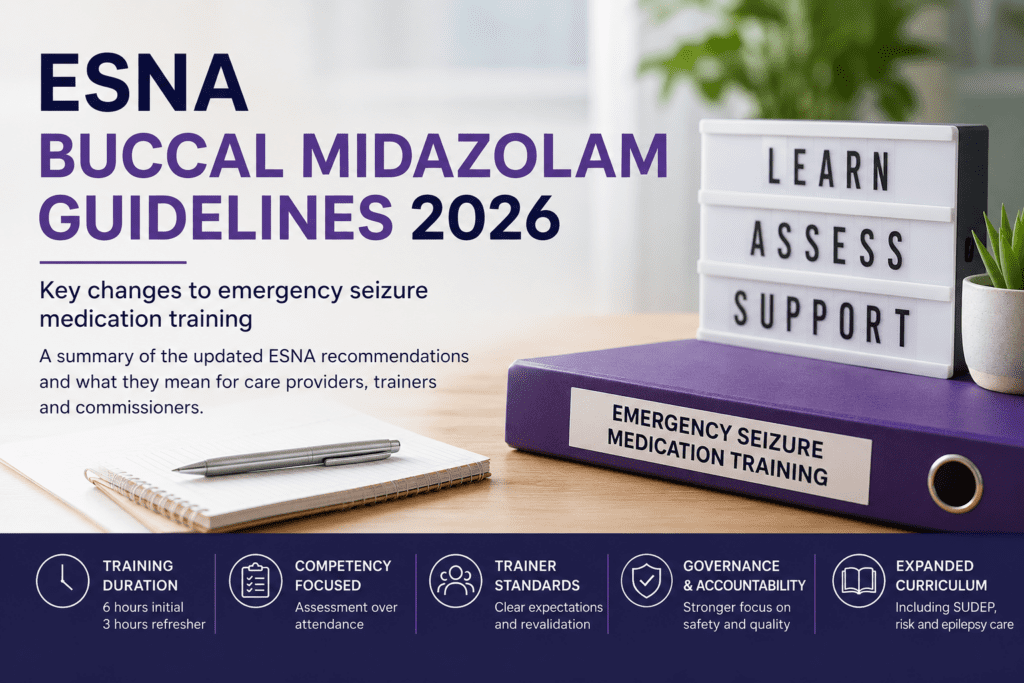
ESNA Buccal Midazolam Guidelines 2026: Key Changes to Emergency Seizure Medication Training
ESNA Buccal Midazolam Guidelines 2026: Key Changes to Emergency Seizure Medication Training
The Epilepsy Specialist Nurses Association (ESNA) has published its updated ESNA Buccal Midazolam Guidelines 2026, providing revised best practice recommendations for the training, assessment and governance of emergency seizure medication administration in community settings.
For organisations delivering or commissioning Buccal Midazolam training, epilepsy awareness training, or emergency seizure medication training, understanding these recommendations is important when reviewing workforce competence, governance arrangements and clinical safety systems.
Whilst the ESNA Buccal Midazolam Guidelines are not mandatory requirements or legislation, they are likely to influence future commissioning decisions, training programmes, competency frameworks and quality assurance processes throughout health, social care and education sectors.
In this article, we examine the key changes and explore how Guardian Angels Training has already incorporated many of these principles into its epilepsy and rescue medication training programmes.
What Are the ESNA Buccal Midazolam Guidelines?
The ESNA Buccal Midazolam Guidelines are best practice recommendations developed by the Epilepsy Specialist Nurses Association to support the safe administration of emergency seizure medication by professional carers and support staff.
The guidance focuses primarily on:
- Buccal Midazolam administration
- Emergency seizure medication training
- Epilepsy awareness
- Competency assessment
- Governance and accountability
- Train-the-Trainer standards
- Emergency care planning
- Risk management
The 2026 edition replaces the previous 2023 guidance and reflects updated evidence, expert consensus and developments within epilepsy care.
Why Were the ESNA Midazolam Guidelines Updated?
The revised guidance was developed following:
- Findings from the REMIT (Rescue Epilepsy Medication and Training) study
- Feedback from epilepsy specialists and educators
- Advances in epilepsy care
- Concerns regarding variation in training quality across the UK
- A desire to improve consistency in emergency seizure medication training
The overarching aim is to support safer, more consistent care for people who may require emergency seizure medication during prolonged or cluster seizures.
ESNA Buccal Midazolam Guidelines 2026: Summary of Key Changes
| Area | Previous Position | 2026 ESNA Recommendation |
|---|---|---|
| Training Duration | Variable | Recommended minimum 6 learning hours initially, 3 hours refresher |
| Refresher Training | Recommended | Recommended every 1–2 years |
| Trainer Standards | Less defined | New competency-based trainer framework |
| Train-the-Trainer | Variable approaches | ESNA proposes national oversight model |
| Assessment | Attendance often accepted | Greater emphasis on demonstrated competence |
| Delivery Methods | Mixed approaches | Face-to-face identified as preferred approach |
| Competency Reviews | Variable | Two-yearly revalidation recommended |
| Curriculum | Core epilepsy content | Expanded curriculum including SUDEP, governance and risk assessment |
| Online Training | Widely used | Online-only training not recommended for medication administrators |
| Governance | Limited detail | Stronger focus on accountability and documentation |
Greater Emphasis on Buccal Midazolam Competency Assessment
One of the most significant messages within the ESNA Buccal Midazolam Guidelines is that attendance alone should not automatically be considered evidence of competence.
The guidance recommends that organisations assess learners using a combination of:
- Practical demonstration
- Scenario-based discussions
- Verbal questioning
- Written questioning
- Observation of practice
This reflects a growing movement throughout healthcare towards competency-based assessment rather than attendance-based certification.
For organisations supporting people with epilepsy, this means ensuring staff can demonstrate safe decision-making and practical skills, not simply attend a training course.
Face-to-Face Buccal Midazolam Training Remains the Preferred Approach
The ESNA guidelines identify face-to-face training as the preferred method for teaching practical skills including:
- Seizure first aid
- Seizure recognition
- Emergency response
- Buccal Midazolam administration
However, the guidance also recognises that:
- Blended learning may be appropriate
- Live virtual learning may be suitable in certain circumstances
The guidelines advise against relying solely on pre-recorded online learning where staff are expected to administer emergency seizure medication.
Recommended Duration for Buccal Midazolam Training
Initial Buccal Midazolam Training
ESNA recommends a minimum of:
- 6 Total Learning Hours
Including:
- Theory
- Practical demonstrations
- Skills development
- Reflection
- Assessment
Buccal Midazolam Refresher Training
ESNA recommends a minimum of:
- 3 Total Learning Hours
Recommended every one to two years.
Expanded Epilepsy Training Curriculum
The updated guidance extends beyond medication administration and includes broader epilepsy-related learning.
Epilepsy Awareness
- Causes of epilepsy
- Diagnosis
- Seizure classification
- Triggers
- Treatment options
Emergency Seizure Management
- Seizure first aid
- Status epilepticus
- Escalation procedures
- Emergency services involvement
Safety and Governance
- Risk assessment
- Accountability
- Documentation
- Safeguarding
- Communication
SUDEP Awareness
For the first time, Sudden Unexpected Death in Epilepsy (SUDEP) is firmly embedded as a core training topic, reflecting growing recognition of its importance in epilepsy care.
ESNA Buccal Midazolam Train-the-Trainer Recommendations
One of the most widely discussed aspects of the updated guidance is ESNA’s proposal to oversee Buccal Midazolam Train-the-Trainer programmes.
The recommendations include:
- Defined trainer competency levels
- Educational qualification recommendations
- Revalidation every two years
- Ongoing CPD
- Clinical oversight
- Quality assurance arrangements
The intention is to improve consistency across epilepsy Train-the-Trainer programmes and support safer emergency seizure medication training nationally.
How Guardian Angels Training Already Aligns With and Exceeds Many ESNA Buccal Midazolam Guideline Recommendations
Whilst the publication of the ESNA Buccal Midazolam Guidelines 2026 is an important development, many of the recommendations reflect approaches that Guardian Angels Training has championed for many years.
Competency Before Certification
Long before the publication of the updated guidance, Guardian Angels Training had already adopted a competency-focused approach through:
- Practical assessment
- Scenario-based learning
- Competency discussions
- Reflective practice
- Knowledge assessment
- Workplace competency frameworks
Programmes That Meet or Exceed Recommended Learning Hours
Many of our epilepsy and Buccal Midazolam training programmes already meet or exceed the learning hours now recommended within the ESNA guidance.
Strong Governance and Quality Assurance
Guardian Angels Training is proud to be:
- Skills for Care Quality Assured Learning Service (QALS)
- Holder of the Skills for Health Quality Mark
- Trusted by NHS organisations, hospices, social care providers, local authorities and educational establishments throughout the UK
Experienced Clinical Educators
Our trainers possess extensive experience in epilepsy care, emergency seizure medication, learning disability services, community healthcare and clinical education.
Established Train-the-Trainer Expertise
Guardian Angels Training has delivered Train-the-Trainer programmes and regulated teaching qualifications for many years, including the Level 3 Award in Delivering Training and Level 3 Award in Education and Training.
Frequently Asked Questions About the ESNA Buccal Midazolam Guidelines
Are the ESNA Buccal Midazolam Guidelines mandatory?
No. The ESNA Buccal Midazolam Guidelines are best practice recommendations rather than statutory requirements or legislation.
Has Buccal Midazolam training changed in 2026?
The updated guidance places greater emphasis on competency assessment, governance, trainer standards and practical learning.
How long should Buccal Midazolam training last?
The guidance recommends a minimum of six learning hours for initial training and three learning hours for refresher training.
Does Buccal Midazolam training require practical assessment?
The guidance recommends that competence should be demonstrated through questioning, observation, practical activities and scenario discussions.
Who can deliver Buccal Midazolam training?
The guidance outlines recommendations for healthcare professionals, Train-the-Trainer facilitators and certain non-clinical in-house trainers operating under appropriate governance arrangements.
Final Thoughts
The ESNA Buccal Midazolam Guidelines 2026 represent the most comprehensive guidance ESNA has produced regarding emergency seizure medication training.
Although the document does not introduce new legal requirements, it provides a detailed benchmark that organisations may choose to use when reviewing epilepsy training, Buccal Midazolam administration training and Train-the-Trainer programmes.
The strongest themes throughout the guidance are competency, consistency, accountability and patient safety.
Looking for Buccal Midazolam Training?
Guardian Angels Training delivers:
- Epilepsy Awareness Training
- Buccal Midazolam Training
- Emergency Seizure Medication Training
- Buccal Midazolam Train-the-Trainer Programmes
- Epilepsy Instructor Training
- Competency Assessment Programmes
Contact Guardian Angels Training today to discuss your requirements.